The future of New Development Bank's contribution to BRI and green finance initiatives
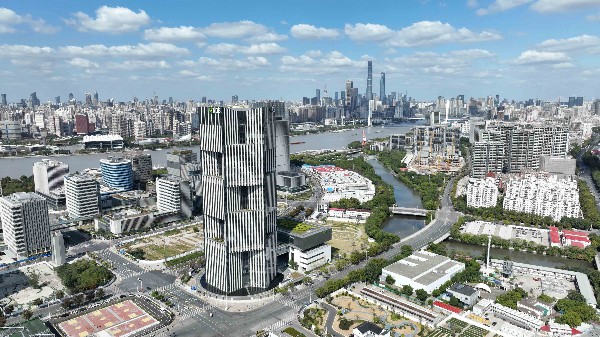
Photo shows the headquarters building of the New Development Bank (NDB), also known as the BRICS bank, in east China's Shanghai. (Photo courtesy of the New Development Bank)
The New Development Bank (NDB) is a product of the further maturation of the BRICS cooperation mechanism: the initiative to set up a multilateral development bank was first put forward at the fourth BRICS leaders summit in New Delhi in India in 2012, and consensus was reached on at the sixth BRICS summit in Fortaleza, Brazil 2014.
At both meetings, I was president of Brazil. Under the theme "Sustainable solutions for inclusive growth," the five BRICS countries announced the signing of the agreement on the New Development Bank in Brazil in 2014. In 2015, the BRICS's NDB was formally established, focusing on the two major areas of "infrastructure development" and "sustainable development projects." The central idea is that the NDB shall mobilize resources for infrastructure and sustainable development projects in the NDB member countries, in complement of existing multilateral and regional development financial institutions.
Based on our strategy, sustainable infrastructure development is at the core of the Bank's financing methodology, with about two-thirds of its lending going to projects in this area. Such projects effectively and strategically mobilize financial, and more importantly, social resources for sustainable infrastructure development of emerging markets and developing countries (EMDCs), in the fields of green recovery and inclusive economic growth. In addition, taking into account the specific period of history that we are in, post-COVID-19 recovery and climate change are by nature also at the core of the Bank's vision. Furthermore, the Bank's concept of development is based on the understanding that always must be sustainable and inclusive.
It is, also, highly-relevant to mention that, the NDB strategy is grounded on the understanding of challenges faced by globalization in recent years. Various crises have been shaking the process of globalization. The future of political globalization is at stake, and global economic relations are being reshaped. Rules and practices of international trade and finance are being fundamentally rewritten and transformed in ways history has never seen. Linkage in science and technology between Asia, North America, Latin America, Africa and Europe, which has been strengthening over the past three decades, is also going through a dramatic process of reshaping. Such changes impose grave risks on the world's stability and prosperity. If not managed efficiently and sufficiently, such risks may well be both reasons and results of global political polarization. As a result, the world economy will be disintegrated into blocs. The world economy is threatened by all kinds of protectionism currently and maybe in the coming years. The objective of economic protectionism is economic hegemony, and it also means to suppress and contain the emerging economies. For these economies, this will lead to reduction of political space for their activities and the shrinking of margin for growth.
In reality, the threat of unilateralism and protectionism is posing many challenges to developing countries. The weaponization of sanctions and the "long arm of jurisdiction" do not solve any problems, but only create more difficulties and inequalities of opportunity for economic growth and social development, affecting the growth prospects of the world economy.
In that context, as an important participant in the new international financial architecture, the NDB is committed to prioritizing the use of local currencies for financing, while at the same time mobilizing funds in a wide range of currencies and markets.
The NDB also is dedicated to devising solutions, to address the mismatch between project cash flows and the needs of sustainable infrastructures in EMDCs and the NDB is aiming at financing in a targeted and customized manner, helping the emerging economies not only to gain economic growth, but most importantly, to achieve economic inclusiveness.
In order to counterplay and mitigate the weakening of globalization, the NDB and Belt and Road Initiative (BRI) join forces to create, develop and strengthen regional markets in EMDCs, to support and foster multilateral cooperations.
Within this scenario, the proposition of the BRI is an excellent example of aligning infrastructure projects with economic growth and social inclusion. The essential linkage between the NDB policies and the BRI is that the NDB not only provides financing and overcomes market failure, but also promotes technological progress and innovation demonstration. Both the NDB and the BRI through its projects have strengthened infrastructure in partner countries, helping them pursue their development goals and bolster their industry, value, and supply chains.
When we understand the BRI in its essence we realize that the BRI is not only about building roads, railways, ports, dams and other infrastructure facilities, but rather a major global opening up initiative that creates a new international cooperation platform. On the one hand, the BRI has helped build hundreds of industrial parks around the world and also facilitated the development of e-commerce through the digital silk road in different regions and countries, and promotes green development. On the other hand, the BRI is helping a large part of the global economy to shift to the green development path. The BRI focuses on planning and building large-scale infrastructure development projects; improving connectivity: facilitating cross-border trade and investment in different regions of the world; boosting cooperation among economies and increasing people-to-people exchange.
As we know, infrastructure financing is characterized by large up-front investment, long construction period, high political sensitivity, high professionalism, etc., which is risky, and privately financed infrastructure projects are prone to insufficient funds and face the dilemma of "market failure." In addition, sustainable infrastructure financing also faces special risks and obstacles, including political and institutional factors, economic factors, market environment factors and project-level factors, etc. The provision of preferential funding by the NDB is conducive to overcoming market failure and obstacles to sustainable infrastructure financing, it therefore plays a leveraging role in attracting social capital into the fields of sustainable infrastructure investment and financing. I believe the NDB and the BRI share the same vision in this sense.
In essence, sustainable infrastructure construction and development require the promotion of technological progress and innovation demonstration. At present, the technological level of sustainable infrastructure in countries along the Belt and Road is relatively moderate and, they are striving to foster innovation as one of the core elements of the initiative. At the same time, the investment uncertainty and risk of technological obsolescence associated with technological innovation also make countries along the Belt and Road face a larger financing gap in this area than in general infrastructure. The degree of development and utilization of new technologies is an important criterion for the NDB to select sustainable infrastructure projects. Multilateral development banks take into great consideration the political and economic influence of multilateral sovereign governments, to promote demonstration projects for technological innovation in order to leverage investment in innovation.
Based on these settings, the NDB is entering a new momentum by welcoming new members such as Bangladesh, the UAE, Egypt and other members that are part of the BRI that may join. As the name "New Development Bank" suggests, the NDB, with its innovative mission and business model, has become an active force in promoting South-South cooperation and it is already a vital instrument that promotes new initiatives such as the BRI. Nearly 100 projects have been implemented by the NDB in a total investment of $32.8 billion. These successful investments in infrastructure projects have contributed to the rapid development of green finance in countries that are important nodes of the Belt and Road strategy.
Finally, the NDB is working hand in hand with several Belt and Road countries to contribute to a more inclusive and innovative global development.
Dilma Vana Rousseff is the president of the New Development Bank.
(责任编辑:{typename type="name"/})